


0
Bag Items
+

Product Title
Brand Name
$00.00

0

Delete
subtotal
$40
show details
To Pay
$0.00
.svg)
Continue Shopping
You have not added anything yet.
Continue ShoppingThis website collects cookies to deliver better user experience We collect cookies to analyze our website traffic and performance; we never collect any personal data and ensure you have great shopping experience
Access restricted: You must be 21 years or older to enter.
THCa is the raw, non-intoxicating acid form of THC. Heat turns it into delta-9. Here's how they differ in chemistry, on a lab report, on drug tests and under the law.
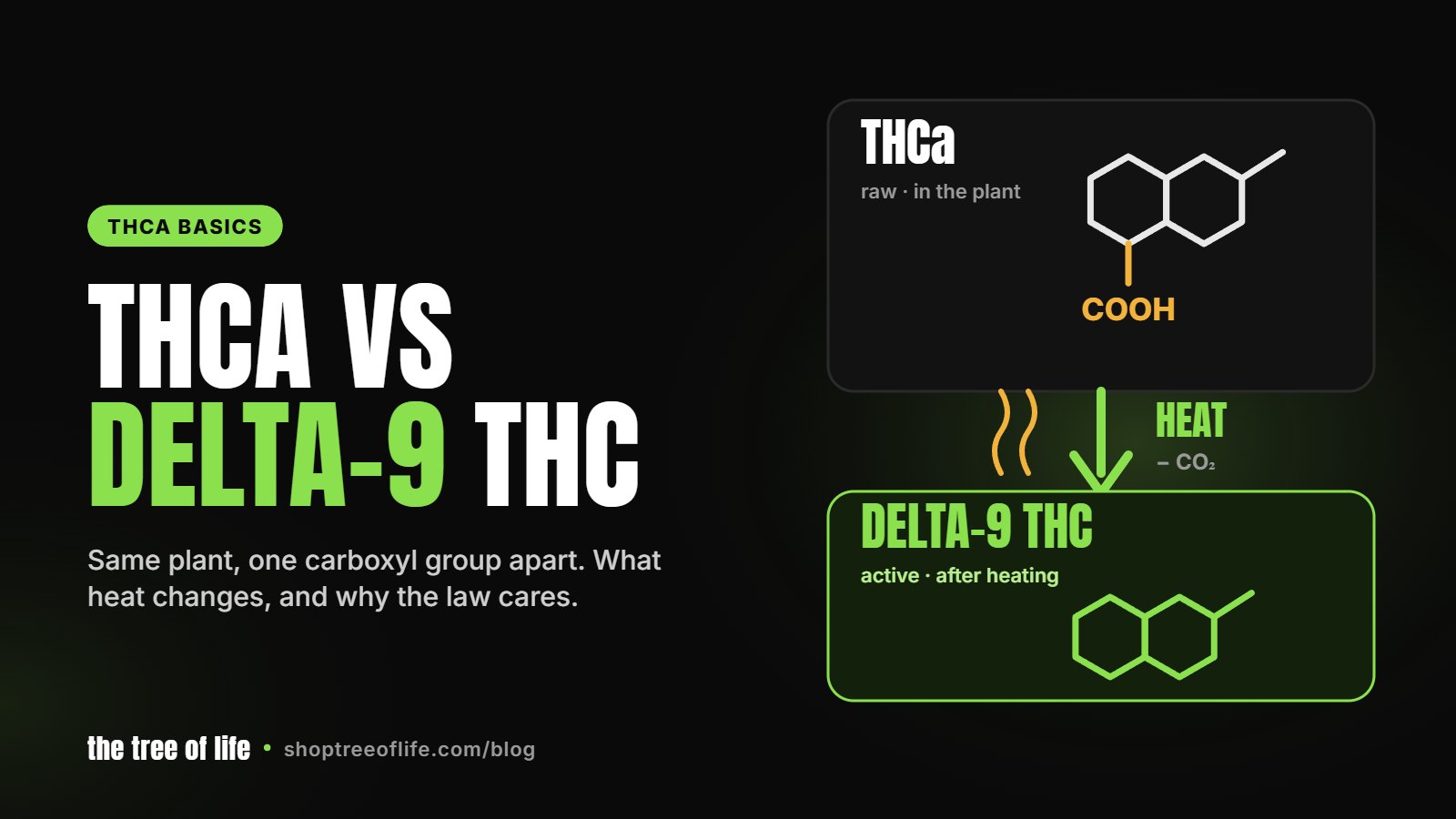
Short answer: THCa (tetrahydrocannabinolic acid) is the raw form of THC that the cannabis plant actually makes. It isn't considered intoxicating on its own. When you heat it by smoking, vaping or baking, it loses a carboxyl group as carbon dioxide and becomes delta-9 THC, the compound that causes a high. So in flower you smoke, most of the THC you get started out as THCa. The big practical differences are how they show up on a lab report and how the law treats them, and that changes on December 11, 2026.
| THCa | Delta-9 THC | |
|---|---|---|
| Full name | Δ9-tetrahydrocannabinolic acid A | Δ9-tetrahydrocannabinol |
| Formula | C22H30O4 | C21H30O2 |
| Molecular weight | about 358.5 g/mol | about 314.5 g/mol |
| Where it comes from | Made by the living plant in its trichomes | Mostly formed when THCa is heated (and slowly with age) |
| Intoxicating? | Not considered intoxicating when unheated | Yes |
| On a COA | Listed as THCA | Listed as Δ9-THC |
| Federal hemp limit until Dec 11, 2026 | Not counted | 0.3% by dry weight |
| Federal hemp limit from Dec 11, 2026 | 0.3% total THC, counting THCa and delta-9 together | |
THCa is the acidic precursor of delta-9 THC. The plant builds it from cannabigerolic acid (CBGA) using an enzyme called THCA synthase, and stores it in the resin glands on the flower (Sirikantaramas et al., 2004). In fresh or cured flower, THCa usually makes up the large majority of the potential THC (Moreno-Sanz, 2016).
Chemically, the only difference is that THCa carries an extra carboxylic acid group (–COOH). Take that group away as CO₂ and you have delta-9 THC.
Not on its own. Researchers describe unheated THCa as the non-psychoactive precursor of THC (Moreno-Sanz, 2016). A receptor study found only weak binding at the CB1 receptor, and some of that was likely from small amounts of THC in the test sample (McPartland et al., 2017).
The catch is heat. USDA's hemp rules describe delta-9 THC as the intoxicating component of cannabis and define decarboxylation as the conversion of THCa into delta-9 THC (7 CFR 990.1). Smoke or vape THCa flower and you're consuming delta-9 THC.
The reaction is called decarboxylation, and it happens three ways:
Because THCa turns into delta-9, labs report both and then calculate the total. The federal formula is:
Total THC = (0.877 × THCa) + delta-9 THC
The 0.877 factor is the weight ratio of the two molecules (314.46 ÷ 358.48). It accounts for the CO₂ that's lost when THCa converts (7 CFR 990.1). Example: flower testing at 25% THCa and 0.2% delta-9 has about 22.1% total THC.
Labs that use liquid chromatography (HPLC) can measure THCa and delta-9 separately. Gas chromatography heats the sample, which converts THCa inside the instrument, so it's less useful for telling them apart (Dussy et al., 2005). For a full walkthrough, read How to Read a COA, or check the numbers for our batches on the lab results page.
It can. Standard urine tests don't look for THCa or THC itself. They look for a THC breakdown product called THC-COOH, with federal workplace cutoffs of 50 ng/mL on the screen and 15 ng/mL on confirmation (49 CFR 40.85). Smoked THCa becomes delta-9 THC, and delta-9 is metabolized into THC-COOH. A drug test can't tell whether THC came from hemp or marijuana (ACMT).
One confusing detail: drug-testing rules abbreviate that metabolite as "THCA" too. In that context it means THC carboxylic acid, not the tetrahydrocannabinolic acid found in flower.
The 2018 Farm Bill capped hemp at 0.3% delta-9 THC by dry weight and said nothing about THCa. High-THCa flower could pass that test while still producing plenty of THC when smoked. A 2025 federal law rewrites the definition to count total THC, including THCa. Most of that change now takes effect on December 11, 2026 after Congress delayed it by about a month (Congressional Research Service). Above 0.3% delta-9, cannabis is marijuana under federal law (21 CFR 1308.11). Our 2026 legal guide covers the details and state-by-state rules.
Hemp delta-9 gummies already contain delta-9 THC. They stay under 0.3% because the limit is a percentage of weight, and a heavy gummy can hold a meaningful dose while staying under it. One analysis of 53 hemp delta-9 products found nearly all were under 0.3% by weight, averaging about 10 mg per serving (Johnson et al., 2023). THCa flower is light, so it relied on low delta-9 before heating instead. The new federal rules affect both: total THC counts THCa, and finished products are capped at 0.4 mg total THC per container.
Curious how individual strains differ? Browse our strain guide.
No. THCa is the acidic precursor that the plant makes. Delta-9 THC forms when THCa is heated and loses a carboxyl group as carbon dioxide.
Unheated THCa isn't considered intoxicating. Once it's heated by smoking, vaping or baking, it converts into delta-9 THC, which is.
Not exactly. THCa is a precursor, not a stronger form. To compare flower, look at total THC on the COA: 0.877 × THCa plus delta-9 THC.
It can. Urine tests look for THC-COOH, a breakdown product of delta-9 THC, and smoked THCa becomes delta-9. Tests can't tell hemp-derived THC from marijuana THC.
THCa loses carbon dioxide when it converts, so it weighs more than the THC it becomes. 0.877 is the ratio of their molecular weights, which gives the most delta-9 that a given amount of THCa can produce.
Not under federal law unless Congress changes it again. From that date, hemp must have 0.3% or less total THC including THCa, and most THCa flower tests well above that.
This article is for general information only and is not legal or medical advice. Laws change often; check your state and local rules before buying. These statements have not been evaluated by the FDA. Our products are not intended to diagnose, treat, cure or prevent any disease. For adults 21+ only. Keep out of reach of children and pets.


